
 Previous
The story behind that old family photo, Cuba 1915
So many questions. Who could possibly know the answers?
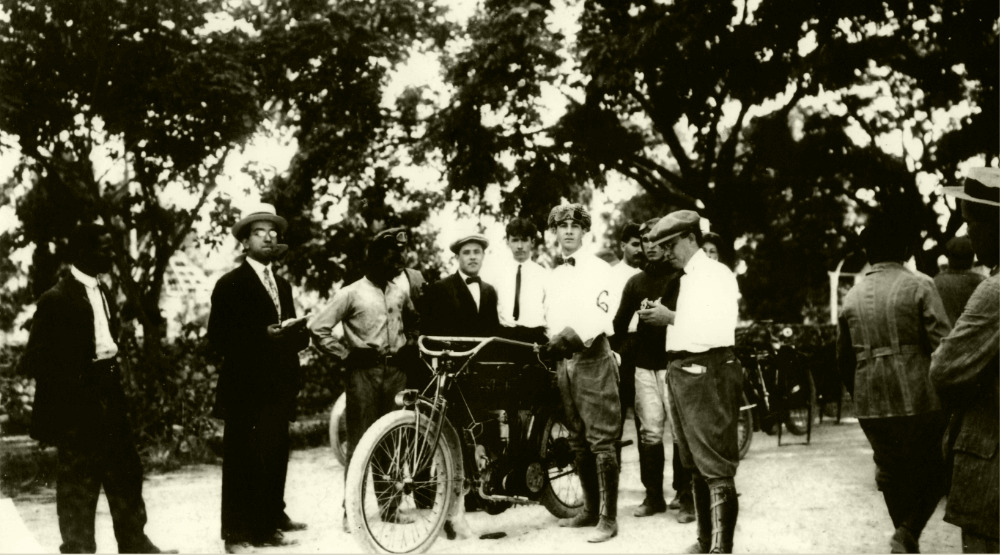
It wasn’t easy to discover why my grandfather was on that Indian Motorcycle in the photograph dated 1915.
But I love a good research challenge, and this project was important to me. I’d barely met my grandfather, and such a story from his lifetime was particular intriguing.
I kept looking occasionally online for clues, but nothing appeared in Google for “René De Zaldo”, “Indian Motorcycle and Cuba”, or other variations I tried.
Instead, I first got lucky uncovering other family stories I had also been searching for.
But eventually, driven by my insistent curiosity, I managed to find enough details to explain what was happening in that image.
It’s hard to describe the feeling – part joy, part “victoire”!
This was early in my family search days, and it had all started because no one in my family, especially my mother, knew anything about her father René’s exciting life as a young man.
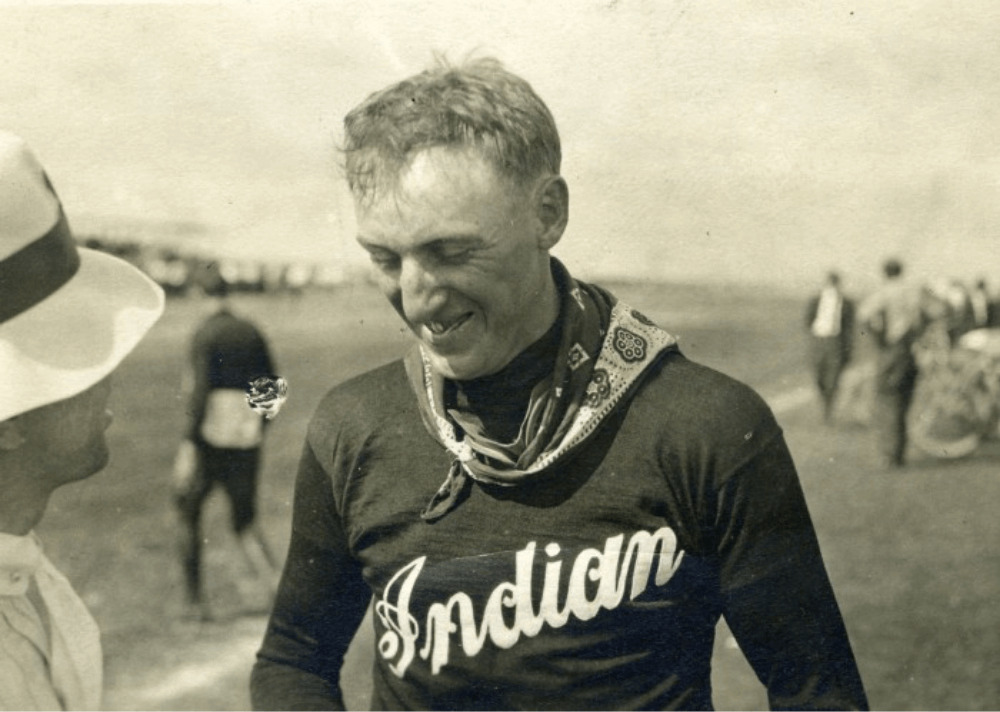
Over the years, I often noticed that old framed photograph of my grandfather, René De Zaldo y Parra. I’d see him standing by his moto, dressed in racing gear and surrounded by other racers and spectators.
I would glance at the image and always wonder:
• When and how did René get interested in motorcycles?
• Where did that scene take place?
• And was it really a race? Did my grandfather win?
Although the people who would remember were gone, I was hoping to find existing information from that era that might hold the answers.
Then, late one night in 2016 while trying a Google search again, I finally came upon the printed resource I had been hoping for.
And as if by some modern form of magic, I was suddenly peeking online into my grandfather’s early life through the pages of old Motorcycle Illustrated magazines.
New digital information had come online
What I had found was a link to a newly digitized collection of the New York City Library.
Volumes of the printed copies of Motorcycle Illustrated, the popular trade magazine first published in 1906, were still in existence and were available at the library.
But with these digital copies, now anyone could easily view several decades of the old magazines online.
This meant that I could search for a key word within the text of the magazines to possibly find information about my grandfather.
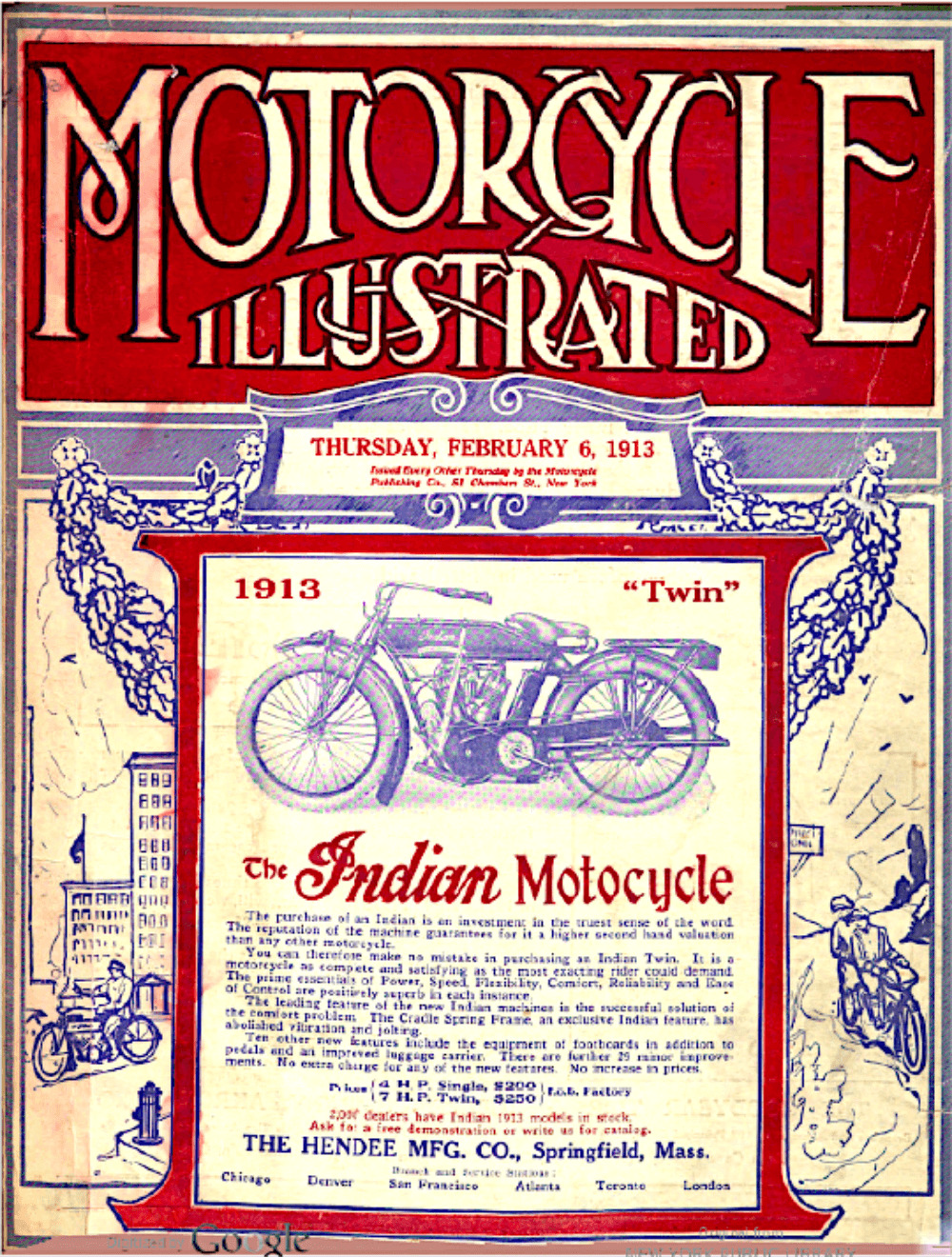
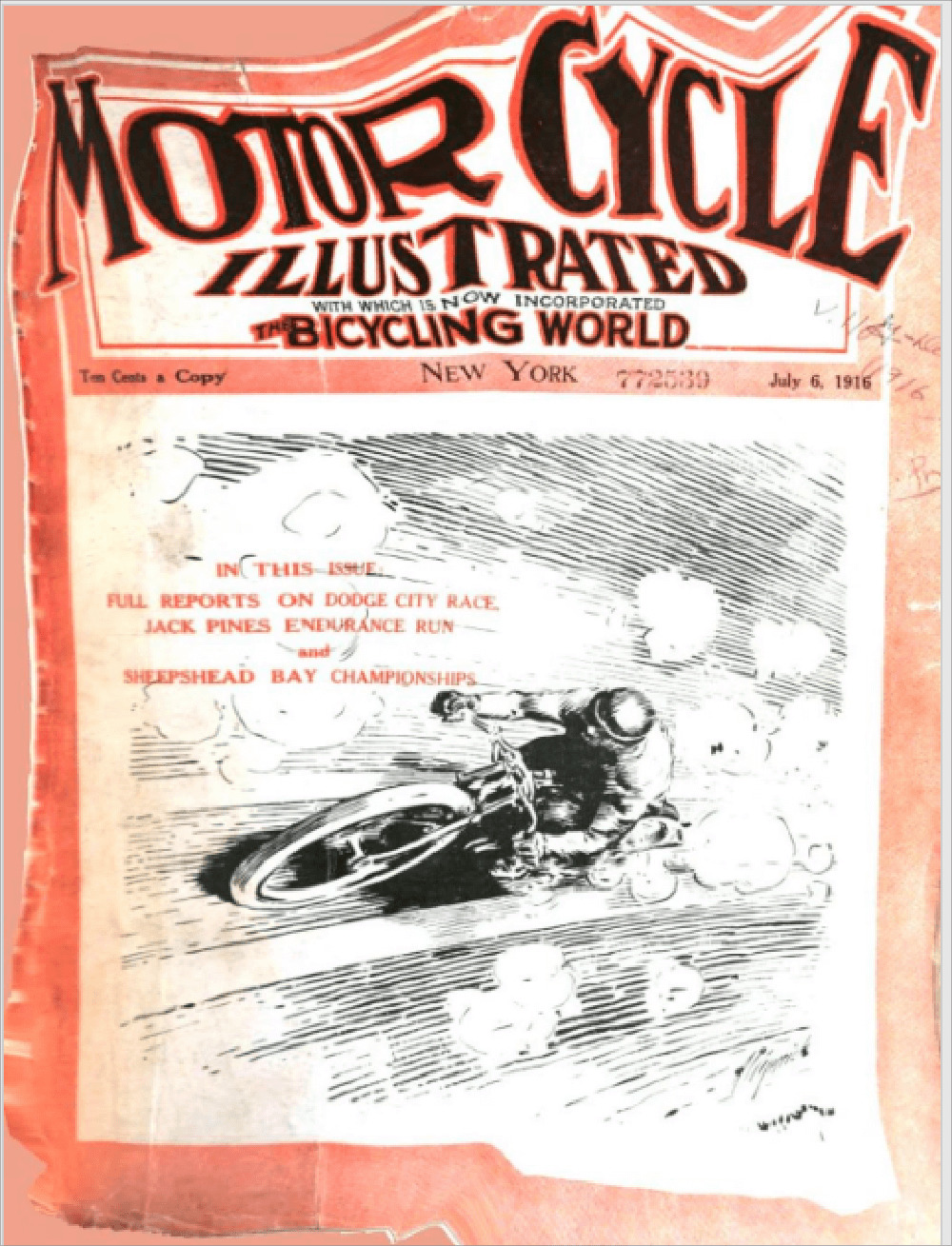
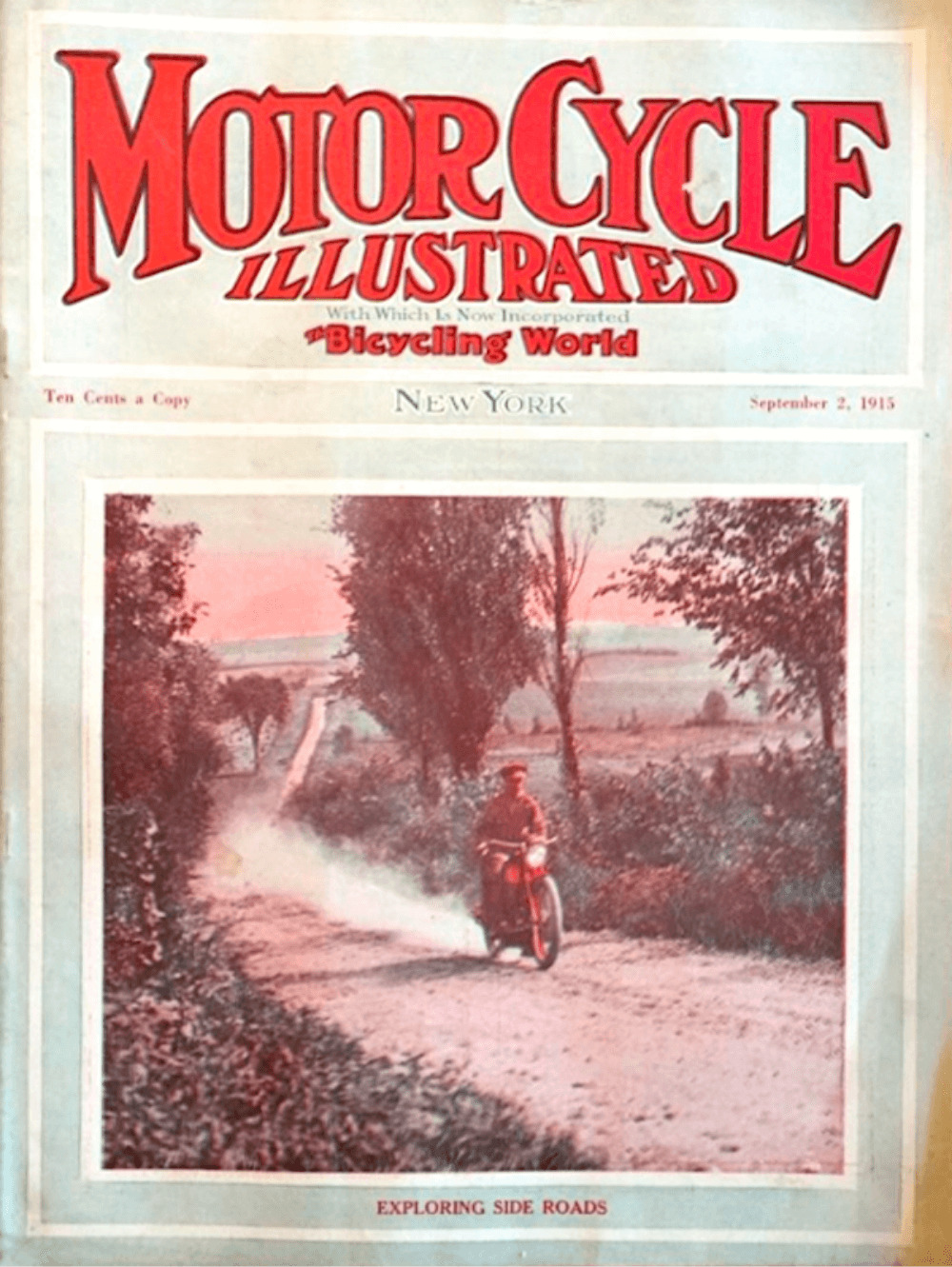
Could my grandfather René be in that popular US magazine?
At first I was surprised that my grandfather would appear in an American magazine. I believed that in 1915 my grandfather René was living in Havana, not the US.
But I was excited that I might find some relevant clues.
After all, René was riding an American brand motorcycle in that old photograph — an Indian Motorcycle.
And I had also found my grandfather traveling from Havana to New York City on several occasions during the 1910s. Maybe his visits to New York had inspired his interest in the new and fast-speed world of motorbikes.
At least, those early issues of the magazine might offer insights about what was happening with motorcycles and the Indian brand in Cuba at the time.
Since the turn of the 1900s, imports from the US were popular and more Americans were traveling to Havana.
Did I find anything good?
I took advantage of the keyword search function for those online issues.
And, yes, I found the clues and the insights I was hoping for.
In fact, those recently digitized copies of Motorcycle Illustrated ended up giving me the answers to just about everything I had wanted to know.
My grandfather was in Motorcycle Illustrated several times in 1915 and 1916
Inside that trade magazine I found surprising details about René. And I followed two years of his life as he traveled between Havana and the US.
I discovered news articles about my grandfather’s activities, even images of him, in several issues from 1915 through 1916.
There were also articles related to Havana and Cuba, describing the popularity of motorcycles and cars on the island or the condition of roads that, by 1916, were being used by a growing number of the world’s first motorized vehicles.
It was a fast-changing era.
With the details in those old magazines, plus other information I had found online, I started piecing together a snapshot of my grandfather as a young man in his mid-20s. It was a part of his life that I knew nothing about, and neither had my mother.
The stories painted a new picture of René and his family during the 1910s.
And they also made me realize from where I might have inherited some of my own interests and personality traits.
René de Zaldo: Indian Motorcycle dealer and motorcycle racer in Havana
It turns out that my grandfather was the Indian Motorcycle dealer in Havana, Cuba, from about 1914 to 1917.
And to answers those early questions I had, he was in race gear in that old photograph because he was competing the “Cuban 68-Mile Classic”, as reported in a 1915 issue of Motorcycle Illustrated magazine.
Did René win that race? Apparently, not.
Instead it was his brother, Rafael de Zaldo, who took 1st Place. (Tio Rafael also rode motorcycles?!?)
Discoveries
René sells the first motorcycles to Havana Police Department, 1915
Motorcycle Illustrated - December 9, 1915
The earliest issue of Motorcycle Illustrated that mentioned my grandfather was from December of 1915.
It featured a photograph of René together with members of the Havana police. Apparently, my grandfather had sold the police department four Indian Motorcycles to use for traffic duty.
These motorcycles were the first ever used by Havana’s police force, replacing horses that had been the form of transportation for centuries.
In the image from the magazine, below, you can see six Havana police officers and a sergeant in their fine uniforms of the day.
Standing behind them is my grandfather. René is dressed in a white linen suit, starched shirt, and a panama hat. He was then a young man of 26 and living in Cuba since 1901.
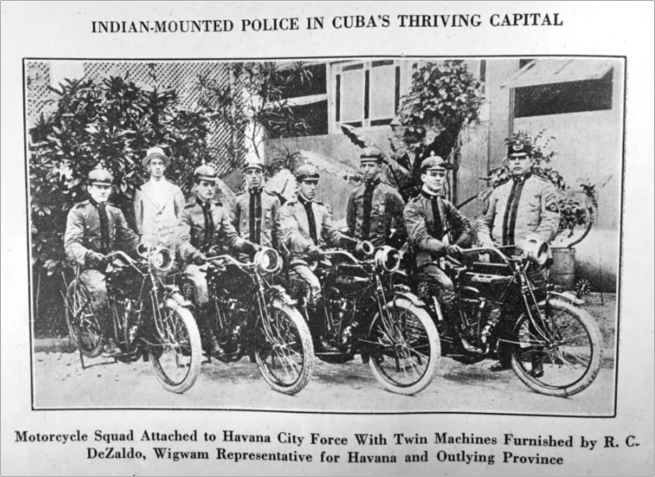
INDIAN-MOUNTED POLICE IN CUBA’S THRIVING CAPITAL
“Motorcycle Squad Attached to Havana City Force With Twin Machines Furnished by R. C. DeZaldo, Wigwam Representative for Havana and Outlying Province”
The caption under the photograph reads:
“Indian-Mounted Police in Cuba’s Thriving Capital – Motorcycle Squad Attached to Havana City Force With Twin Machines Furnished by R.C. DeZaldo, Wigwam Representative for Havana and Outlying Province”
“Wigwam” was Indian Motorcycle’s somewhat witty reference to its headquarters in Springfield, Massachusetts, and “Wigwam Representative” was used to refer to the dealer network.
I don’t know how many Indian motorcycles my grandfather sold during his time as a dealer in Havana, but by 1919 there were _______ registered motorcycles in Cuba, an impressive number.
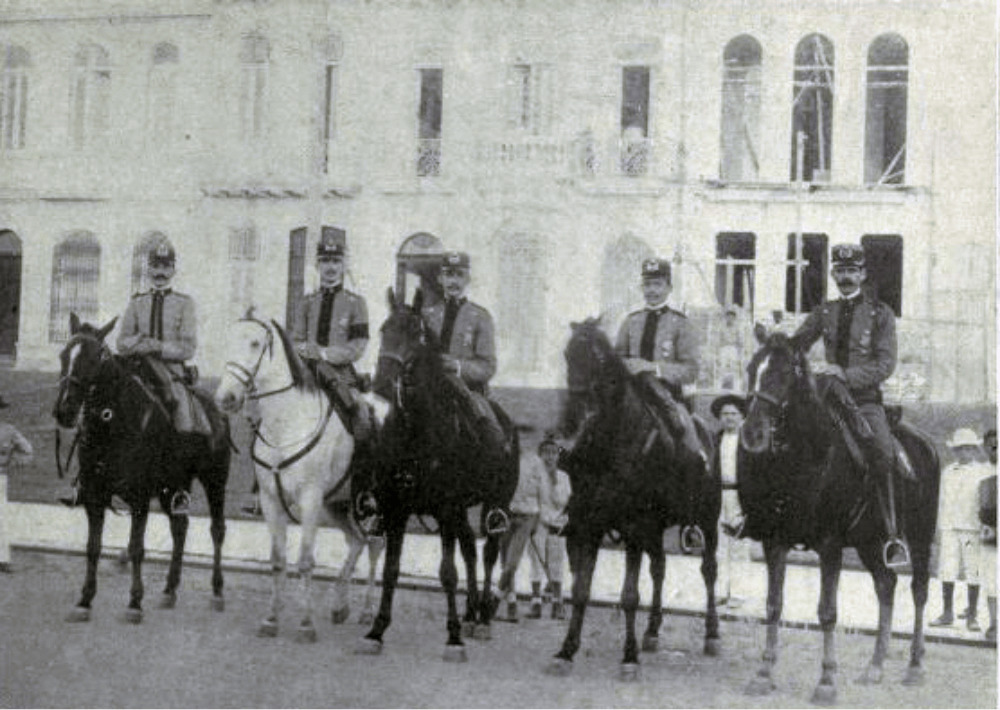
Havana police on horseback, 1913
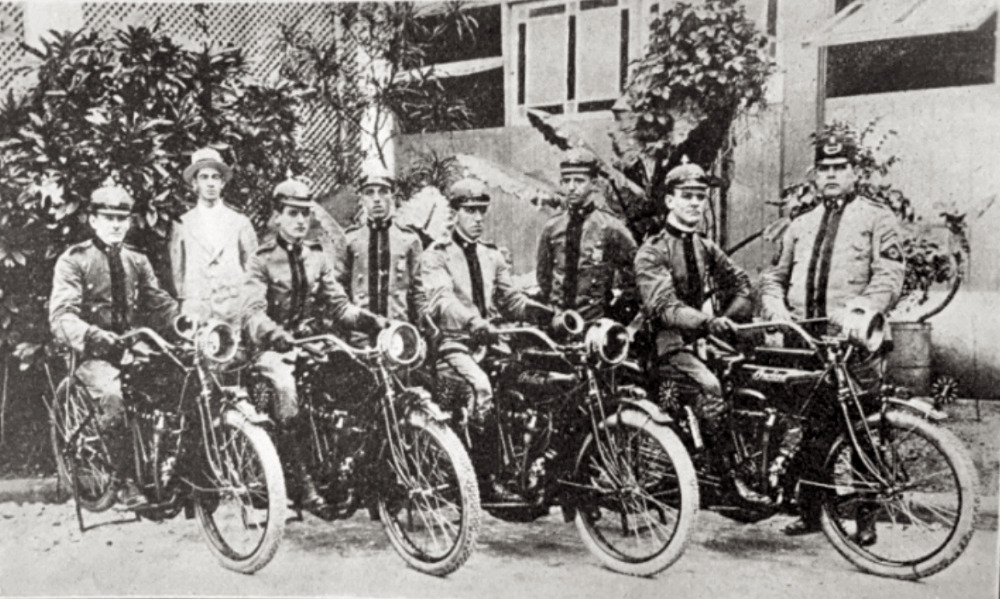
Havana police on Indian Motorcycles, 1915
Rafael, my grand-uncle, also loved motorcycles in Cuba
Motorcycle Illustrated - December 30, 1915
Finding a picture of my grand-uncle Rafael De Zaldo y Parra on a motorbike in Motorcycle Illustrated of 1915 was incredible.
I knew very little about my grandfather’s brother Rafael ― now I knew that both DeZaldo brothers loved to ride.
News about Rafael De Zaldo, or Ralph, winning that race in Havana appeared in the magazine’s issue of December 30, 1915. This report included only a photograph, with a title and caption. But those few words gave me a wealth of information and has kept me searching for more details about motorcycles and vehicle racing in Cuba since the start of the 1900s.
According to one of my cousins, our grandfather said that it was Rafael who was the serious motorcycle racer. He loved to race, and won often.
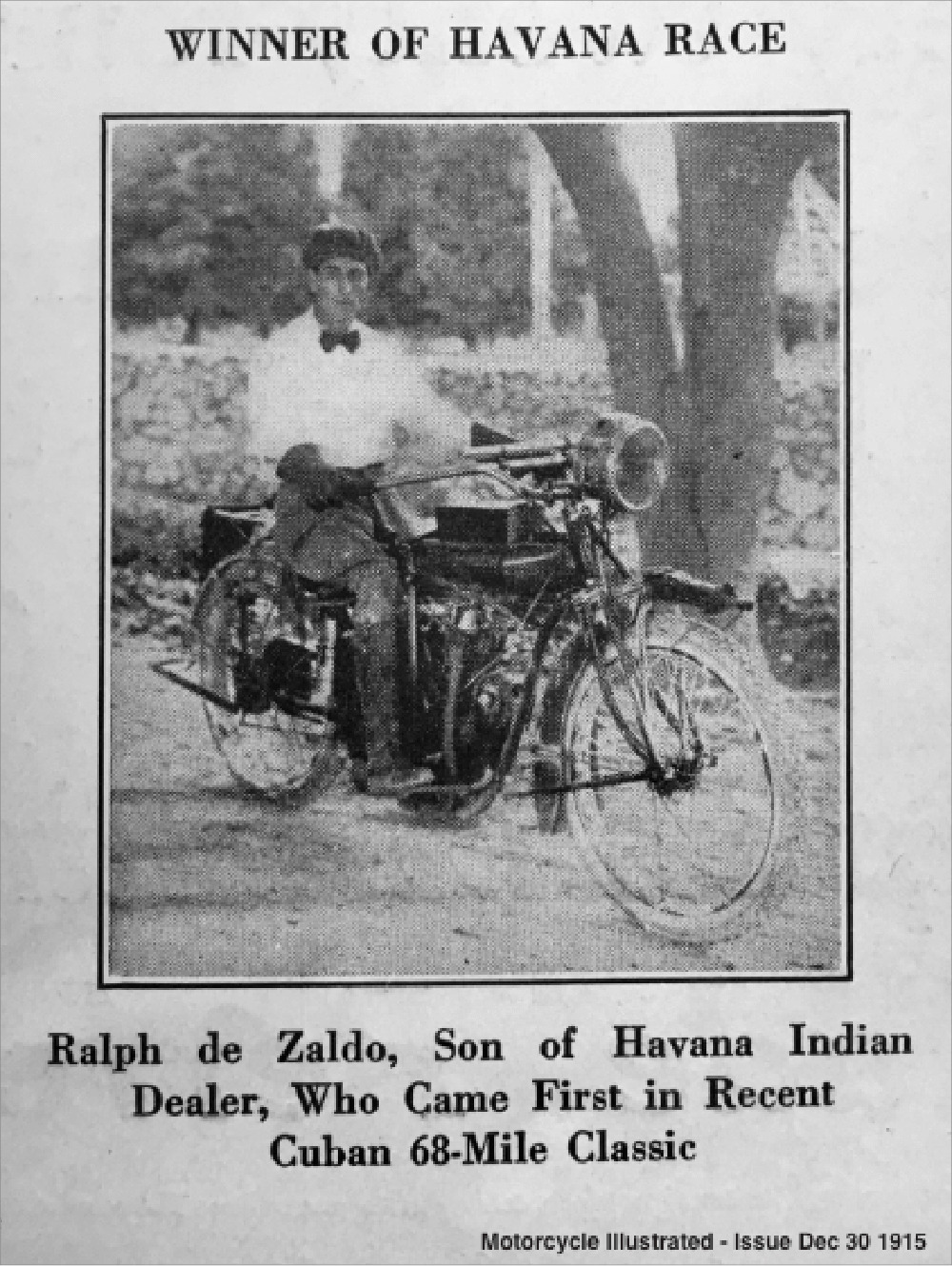
WINNER OF THE HAVANA RACE
“Ralph de Zaldo, Son of Havana Indian Dealer Who Came First in Recent Cuba 68-Mile Classic” The Havana Indian dealer mentioned in the caption was my grandfather. And the winner of that race was not his “son,” but instead his brother, Rafael.
In the image found in the magazine, above, you see Rafael riding the latest model Indian Motorcycle and wearing fine leather riding boots and gloves. He’s also dressed in a white collared shirt, bowtie, and a cap.
Other photographs I’ve seen more recently of Rafael confirm not only that he really enjoyed his motorcycles in Cuba, but he also had a great sense of style.
(Link to posts about the DeZaldo Brothers: LINK)
I’m still not sure where that motorcycle race took place ― it might have been in or near Artemisa, in the Havana area. The caption in this magazine issue called the race the “68-mile Cuban Classic”, yet I haven’t found reference to a race of that name anywhere else.
Can you inherit a love for motorcycles?
I’d never heard anything about a family member interested in motorcycles before my brother found that image of my grandfather on his Indian.
Yet somehow, in high school, motorbikes caught my attention. I eventually got my own motorcycle when my two sons started riding, and I loved speeding on sandy trails and challenging them to dirt jumps.
Then, suddenly, my research led me to discover that both a grandfather and a grand-uncle had been serious motorcycle enthusiasts on the island of Cuba. The DeZaldo brothers, René and Rafael, were confident enough to race those early two-wheeled machines on sandy, dirt roads.
Could I have inherited a thing for motorcycles through in my genes?
René De Zaldo, Indian Dealer in Cuban Capital
Motorcycle Illustrated - September 21, 1916
It was actually my grandfather’s headshot that first appeared to me online from these magazines.
Just imagine ― I’m at my laptop creatively trying to Google something that explains a 100-year old photograph of a man on a motorbike, when, on the screen, I’m presented with a formal photograph of my grandfather.
And below the image I see just a few words that put everything into context. Crazy.
That picture of René, seen below, was included in the September 21 issue of Motorcycle Illustrated of 1916.
René was clearly a well-dressed young man, posed wearing a handsome suit, broad neck tie, and pocket handkerchief in the fashion style of the era.
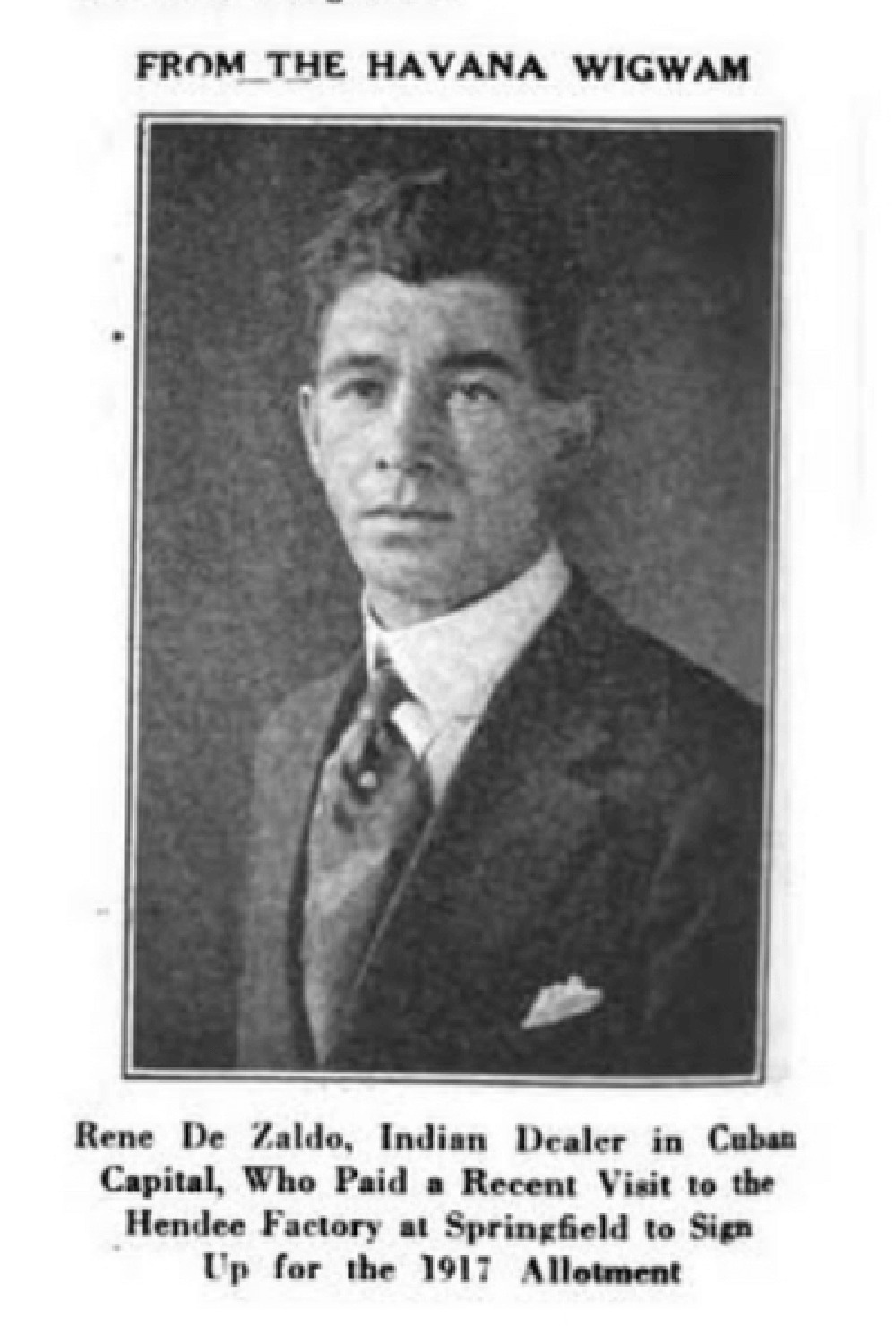
FROM THE HAVANA WIGWAM
“Rene De Zaldo, Indian Dealer in Cuban Capital, Who Paid a Recent Visit to the Hendee Factory at Springfield to Sign Up for the 1917 Allotment”
There was no article associated with my grandfather’s image, which is only explained by the caption below.
But there was enough information in that caption to learn for the first time that my grandfather was indeed the Indian Motorcycle dealer in Cuba and that he was traveling from Havana all the way to Springfield, Massachusetts to visit the manufacturer’s headquarters.
The caption reads:
“FROM THE HAVANA WIGWAM: Rene De Zaldo, Indian Dealer in Cuban Capital, Who Paid a Recent Visit to the Hendee Factory at Springfield to Sign Up for the 1917 Allotment”
Springfield, Massachusetts
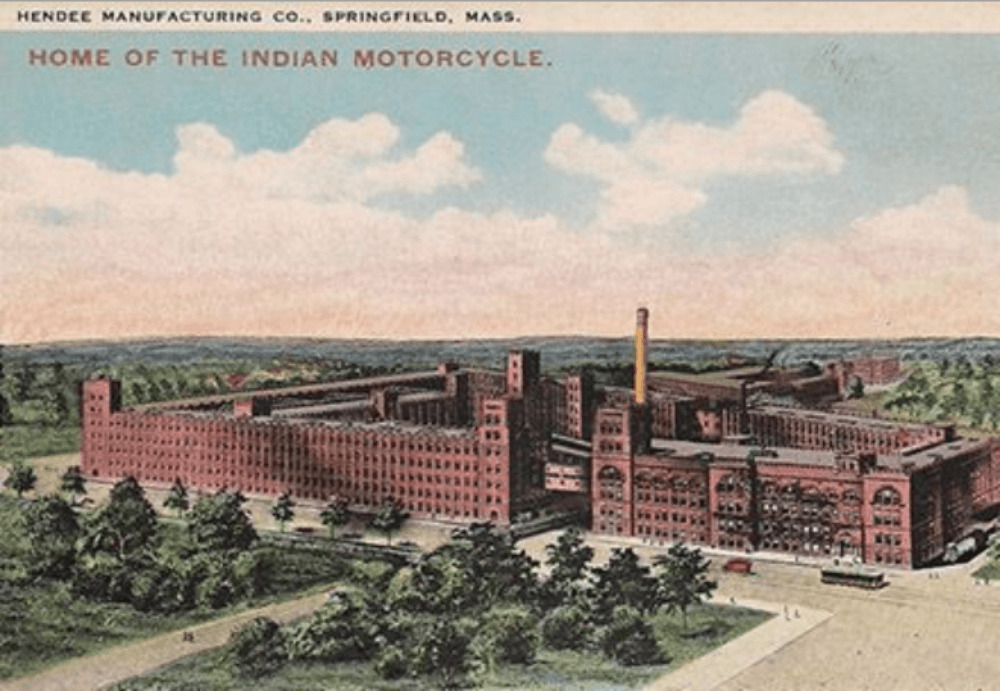
Hendee Manufacturing Company, which started in 1901, was the original name of the factory that made the Indian Motorcycle. The company name was changed to the “Indian Motorcycle Manufacturing Company” in 1923.
Did you know that Indian was America’s first motorcycle company?
(It was 1903 when Harley Davidson started.)
CannonBall Baker in Cuba, 1912?
When I learned that Indian Motorcycle had sponsored the legendary Erwin “CannonBall” Baker in 1912 on a southern trip that took him through Cuba, I wondered: Did the De Zaldo Brothers see CannonBall in Havana?
Learn about CannonBall Baker’s journey in 1912, well before his record-breaking ride across the US in 1914. (LINK to my post …)
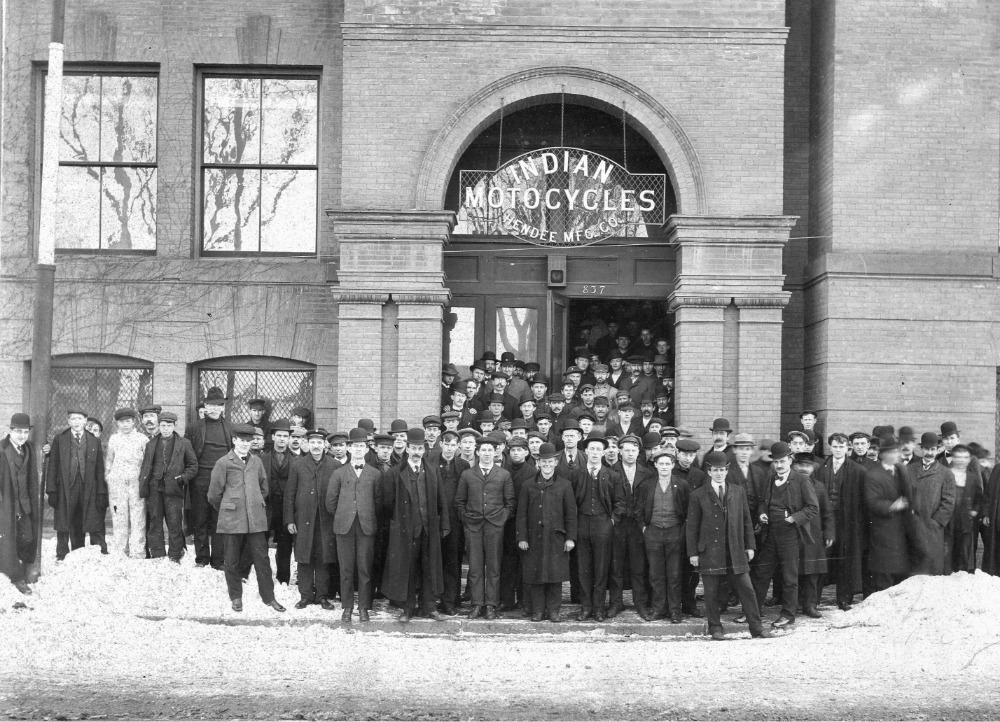
A second visit by René to the Indian Motorcycle headquarters in Springfield, Massachusetts
Motorcycle Illustrated - July 6, 1916
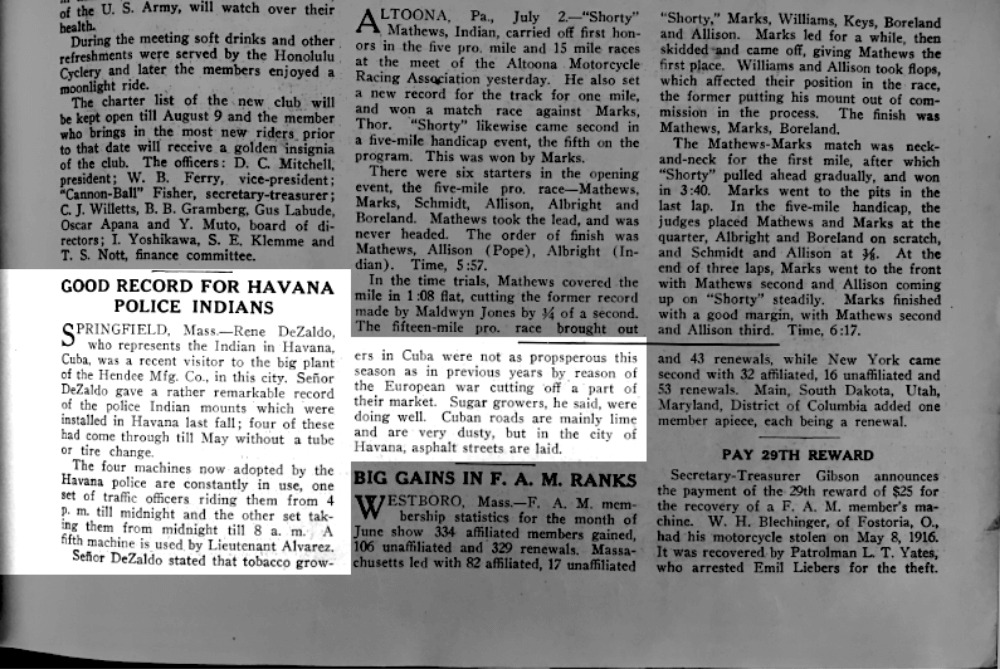
In a July issue, I learned that my grandfather had made an earlier visit to the Indian Motorcycle factory ― separate from the visit mentioned in the issue from September 21, 1916.
The news of this visit was posted from Springfield, Massachusetts, Indian’s headquarters, and it described René’s update to the manufacturer about business in Havana.
GOOD RECORED FOR HAVANA POLICE INDIANS
“Rene DeZaldo who represents the Indian in Havana, Cuba, was a recent visitor to the big plant of the Hendee Mfg. Co. in this city…”
René De Zaldo reports on the Cuba business at Indian Motorcycle headquarters
Per the article in 1916, my grandfather, or Señor De Zaldo, shared some valuable information with headquarters.
First he reported on the great track record of the Indian motorcycles that he had sold to the Havana police the year before. The machines hadn’t even needed a tube or tire change since being put into service.
Señor De Zaldo also summarized about business in Cuba and any affects caused by World War I, which had started in Europe in 1914.
My grandfather also mentioned that roads in the city of Havana were paved and provided good driving conditions for motorcycles and cars.
“Señor De Zaldo stated that tobacco growers in Cuba were not as prosperous this season as in previous years by reason of the European war cutting off a part of their market. Sugar growers, he said, were doing well. Cuban roads are mainly lime and are very dusty, but in the city of Havana, asphalt streets are laid.”
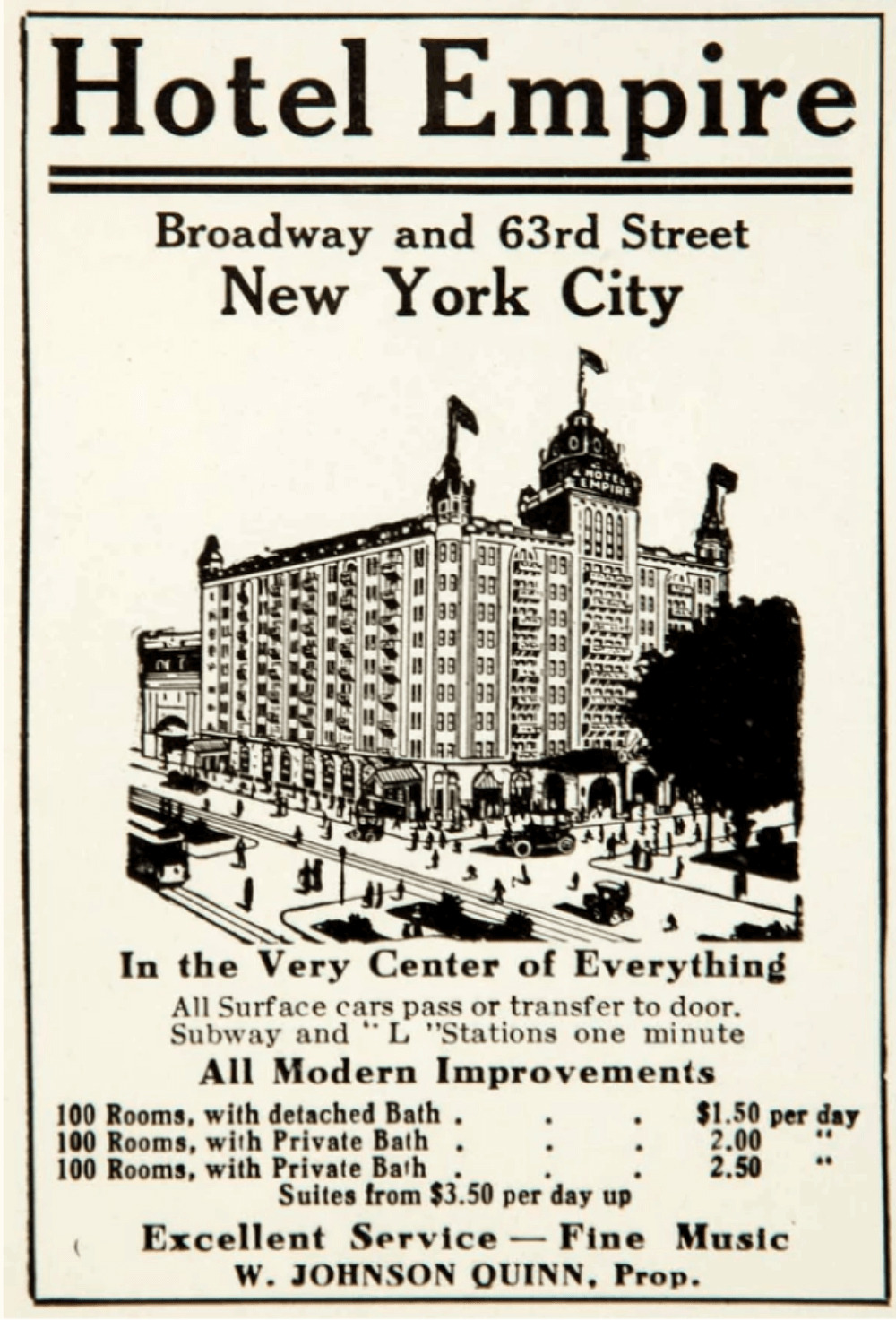
Separately, I had found my grandfather traveling to New York, via Ellis Island, in the summer of 1916. He may have been on his way to visit the Indian factory in Massachusetts.
While in New York for that trip, René stayed at the original Hotel Empire in Manhattan, across from today’s Lincoln Center.
(The hotel building in this image was torn down and re-built in 1922.)
More news on the Havana Police Indian Motorbikes
Motorcycle Illustrated - November 25, 1915
I few articles related to my grandfather and motorcycles in Cuba were harder to discover in the magazine text.
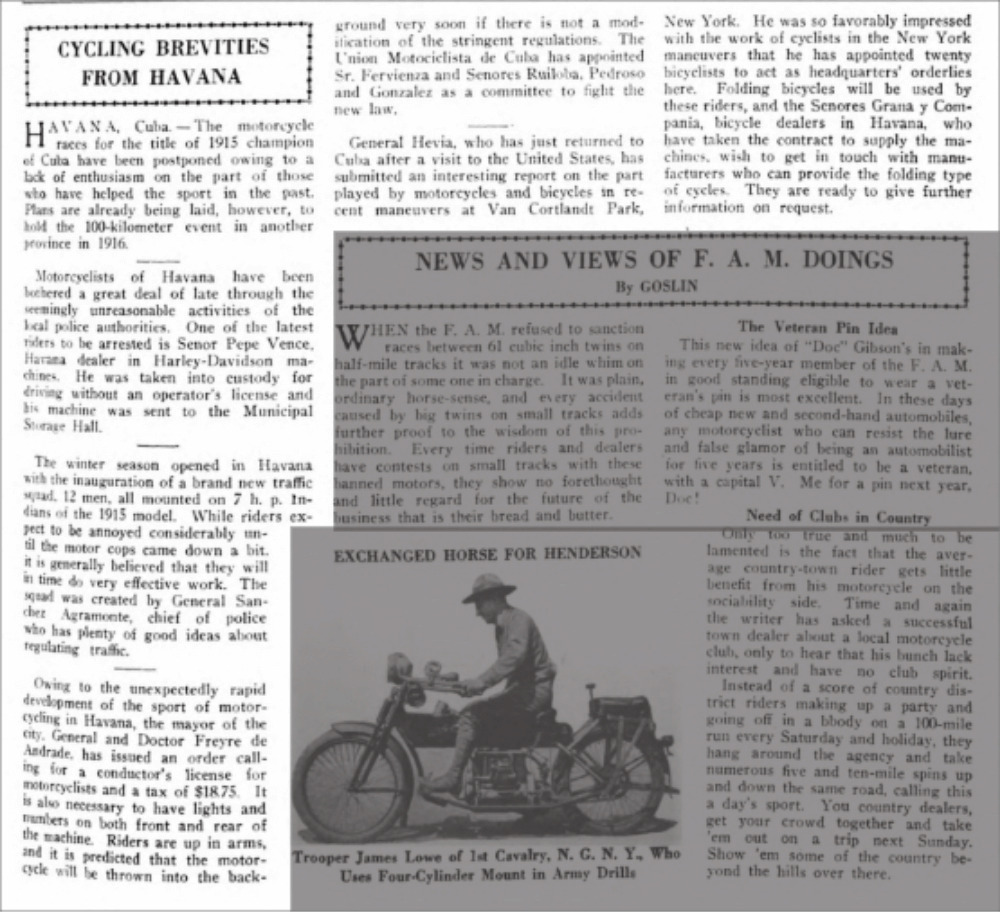
For example, I finally found another report about the Havana police department’s new motorcycles that were sold by my grandfather, René de Zaldo. However, the paragraph didn’t include the words “police,” “motorcycle,” nor “de Zaldo”.
This article I found by text searching for the word “cycling”.
In the 1910s, motorcycles were still associated with bicycles ― they were basically just bicycles with motors. And they were also often called “machines,” “mounts,” and “motorbikes”, so if you searched for “motorcycle” you might miss some relevant news.
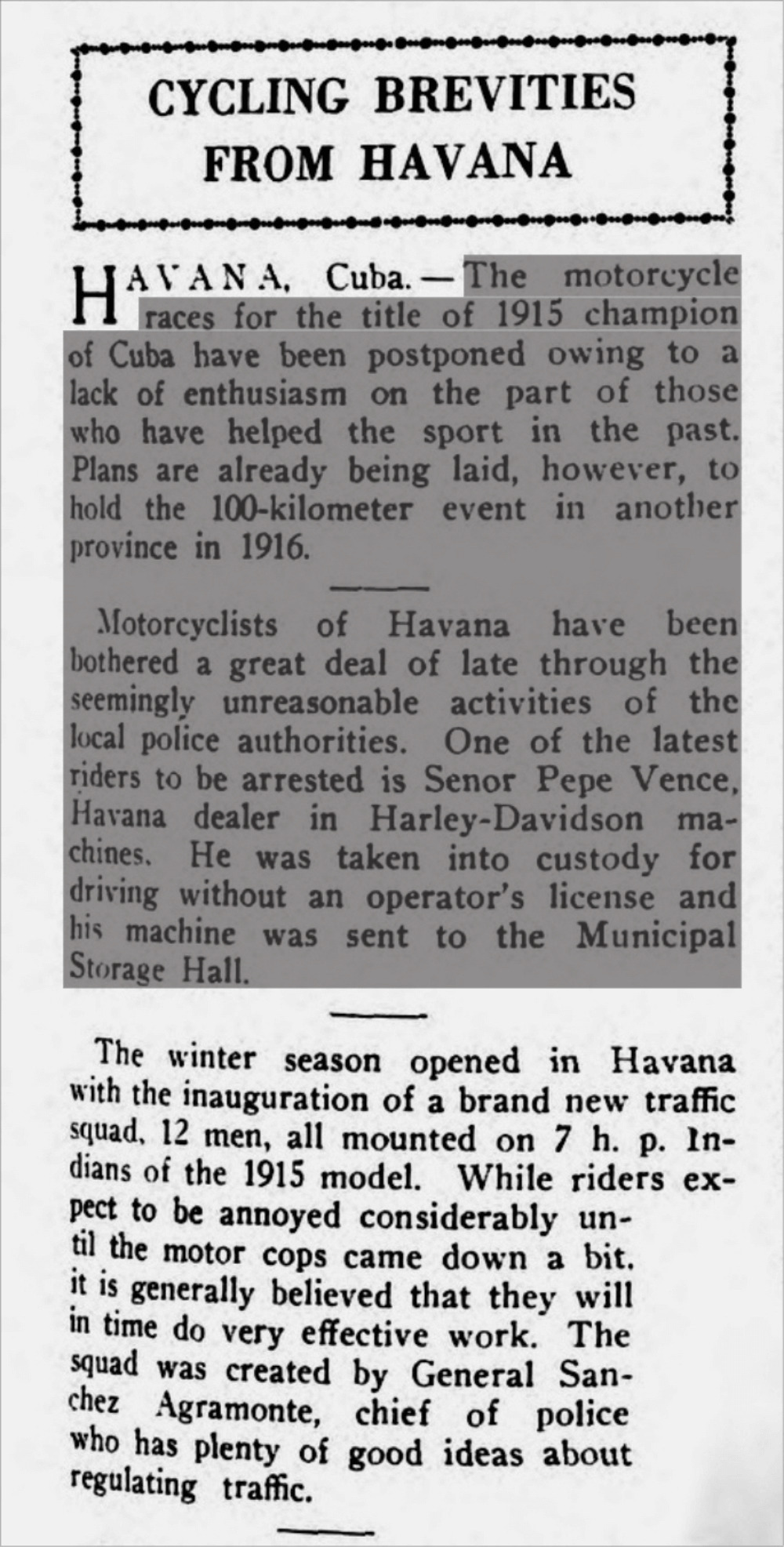
The magazine’s article, below, talks about the “brand new traffic squad” of the Havana Police in the section entitled “Cycling Brevities from Havana”.
You can also read how “speeding” was a new problem on roads and why motorcycle riders in Cuba were up in arms about having to get a driver’s license.
The Harley-Davidson dealer in Havana was even arrested!
CYCLING BREVITIES FROM HAVANA
“The winter season opened in Havana with the inauguration of a brand new traffic squad. 12 men, and mounted on 7 h.p. Indian of the 1915 model.
While riders expect to be annoyed considerably until the motor cops ace down a bit, it is generally believed that they will in time do very effective work.
The squad was created by General Sanchez Agramonte, chief of police who has plenty of good ideas about regulation traffic.”
Research Notes
A lucky find: One more motorcycle image from Havana, 1915
Photo found by just flipping through the 100-year old issues in person
It was only by chance that I found a separate photo of Havana’s police sergeant in Motorcycle Illustrated. It had not come up through a Google search, nor even with a text search within the magazine’s digital files online.
I discovered the image only while flipping though the pages of the real magazines ― original issues that had been printed over a 100 years before.
Visiting the New York City Library in 2019
In 2019, I traveled to the New York City Library in Manhattan to view, and touch, the bound volumes of those old Motorcycle Illustrated issues that are in the library’s collection.
They were the same issues I had seen online, but I wanted to capture some higher resolution images of the articles and the photographs related to my grandfather.
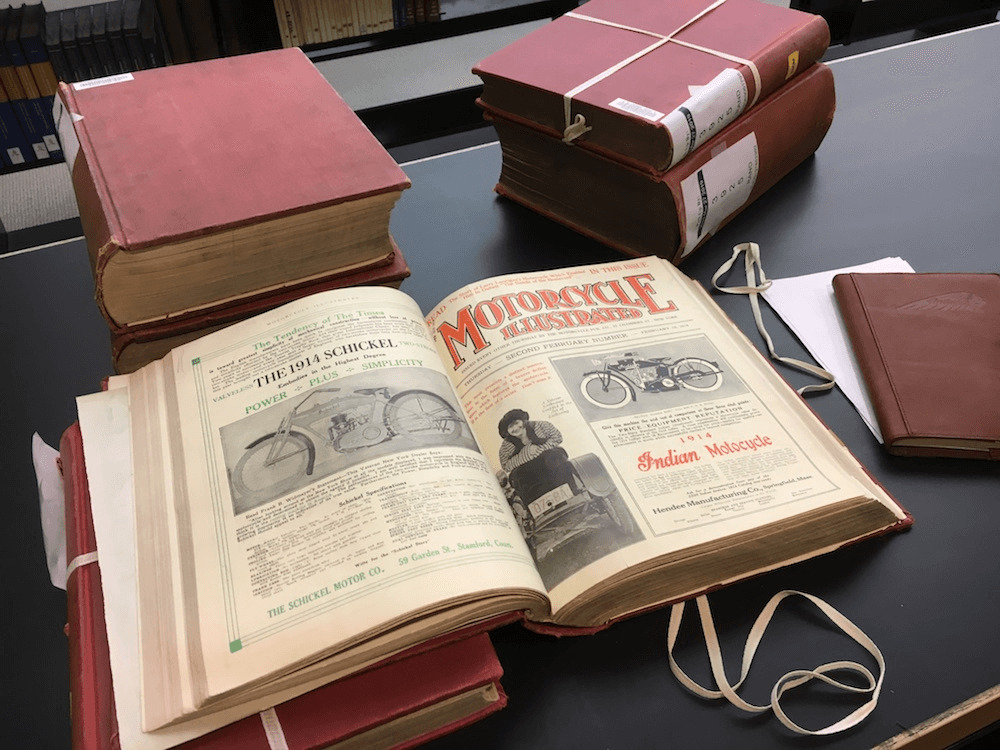
How different it was to be together with those vintage magazines
Looking through those old trade magazines was a very different experience from seeing them online.
It was quite moving to touch (very carefully!) the paper of the printed pages, most of them so well preserved.
And I loved handling the huge volumes of original magazines and carrying them from the Special Requests desk to the large library tables there in Manhattan. (I looked through two dozen bound sets.)
Most of the pages are in black and white, but the vibrant colors of the magazine covers and featured advertisements are rich, and even better when you see them in person.
The graphic designs of the 1910s are wonderful ― a blend of the decorative Art Nouveau style and the practical ad layouts and copy used to entice buyers of those early motorcycles.
I carefully turned each page, taking in the visual details and the simple stories that were considered newsworthy for the time.
And I kept imagining René and Rafael looking through those same issues when they were young, each of them enthralled with the motorized machines they were so crazy about.
The last article I found
Motorcycle Illustrated - November 25, 1915
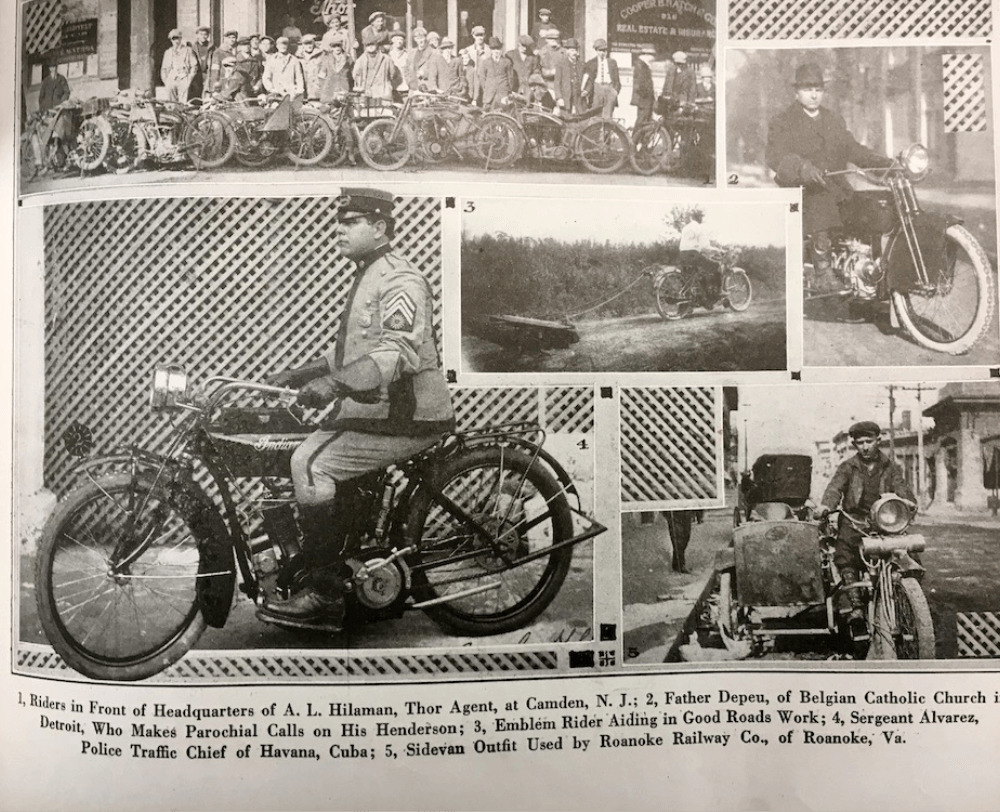
DEMONSTRATING VARIED USES OF POWER TWO-WHEELERS
Par of caption reads: “… 4, Sargeant Alvarez, Police Traffic Chief of Havana, Cuba;…”
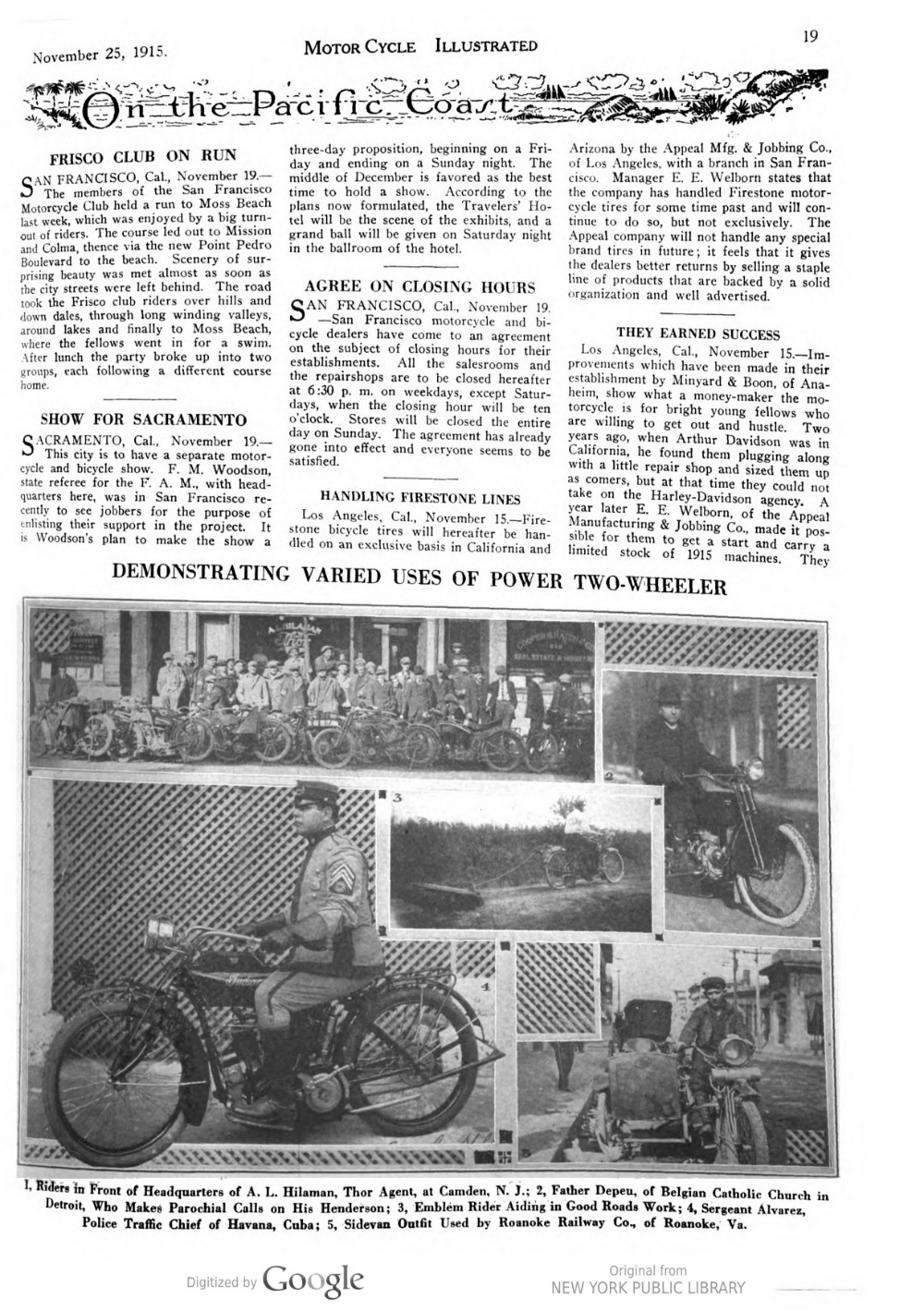
Another photo of an Indian Motorcycle René sold in Havana
Flipping through the printed issues at the library is how I found the image, above.
It was in a volume of magazines from 1915, and I recognized the uniform.
It was familiar because I had seen the same uniform in the photo of my grandfather with the new Havana traffic squad. I took a look at the caption, and sure enough, the caption read, “Sargeant Alvarez, Police Traffic Chief of Havana, Cuba”.
And he was riding the very same Indian Motorcycle that my grandfather René had sold!
The collection of images the magazine had assembled on that page was simply to highlight creative uses of the new moto machine: “Demonstrating Varied Uses of Power Two-Wheeler”.
In the 1910s, sales for motorcycles grew quickly, and riders were excited about the adventures they could take on them.
But they were also harnessing the power in this new vehicle technology to get work done – like leveling a bumpy dirt road or hauling stuff in an empty side car.
In the Cuban capital of Havana, they were also using the motorcycle for work.
Managing the traffic of a growing number of cars and motos was a growing problem by 1915. And it couldn’t be done by the Havana police on horseback, as was the norm just two years before.
Where I Found This Magazine Resource
Copies of original printed issues of Motorcycle Illustrated magazine were located at the New York City Public Library. Then in 2014, they were “Digitized by Google”.
I finally came across the magazines online in 2016.
The library’s collection has only several years of the magazine – from 1908 to 1922. (Fortunately that range was perfect for me to find my grandfather.)
How to access this resource (updated October 2024)
NYC Public Library’s collection, including digitized copies and details to access the print copies in person:
To see the printed copies you must contact the library before your visit to request the volumes you wish to see. (Details in link, above.)
Copies are located at the following library location:
Stavros Niarchos Foundation Library (SNFL)
455 Fifth Avenue Fifth Floor New York, NY 10016
Hathi Trust (“a not-for-profit collaborative of academic and research libraries”) hosts the digital copies of these Motorcycle Illustrated volumes.
You can read them online and download 1 page at a time.
Link to Hathi Trust collection:
https://catalog.hathitrust.org/Record/008608578